Nail fungus is stubborn and persistent — but essential oils have genuine antifungal science behind them. Here is a complete guide to using aromatherapy for nail fungus, including research, protocols, blends, and lifestyle steps.
Nail fungus — medically known as onychomycosis — is one of the most stubborn, persistent, and frustrating conditions to treat. Once a fungal infection establishes itself beneath a fingernail or toenail, it is protected by the hard keratin structure above it, making it genuinely difficult to eliminate with surface treatments alone. Conventional antifungal medications can work, but some carry the risk of serious side effects including liver toxicity — which leads many people to seek natural alternatives.
The good news is that the scientific case for using essential oils against nail fungus is more solid than many people realize. Multiple laboratory and clinical studies have examined the antifungal activity of specific essential oils against the very fungi responsible for nail infections, and the results are genuinely promising.
This guide covers what the research shows, which essential oils work best and why, how to use them in a practical daily protocol, and the important lifestyle and hygiene steps that determine whether any treatment — natural or conventional — succeeds or fails.
Understanding What You Are Fighting
Before choosing a treatment, it helps to understand which organism is causing the infection. The two most clinically relevant fungi in nail infections are:
Trichophyton mentagrophytes (and the related species Trichophyton rubrum) — the primary cause of onychomycosis (nail fungal infections), as well as tinea pedis (athlete’s foot), ringworm, and fungal infections of the beard, scalp, and skin. Dermatophytes like these are the organisms responsible for the majority of nail fungal infections seen in clinical practice.
Candida albicans — a yeast organism that can cause nail infections, particularly in fingernails, and is responsible for a wide range of candida infections throughout the body. Candida nail infections are more common in people who frequently have their hands in water, those who have had antibiotic treatment, or those with compromised immune function.
Knowing which organism you are dealing with matters because some essential oils have better activity against dermatophytes, others against Candida, and some against both. Getting a proper diagnosis from your doctor before beginning any treatment — natural or otherwise — is essential.
What the Research Shows
A study conducted by researchers from the University of the Witwatersrand and Tshwane University of Technology in South Africa specifically examined how different essential oils and combinations of essential oils performed against both Trichophyton mentagrophytes and Candida albicans. The researchers found that sandalwood essential oil, particularly in combination with other aromatic oils, demonstrated the strongest inhibitory activity against Trichophyton mentagrophytes of the oils tested. Rose geranium and German chamomile also showed noteworthy antifungal activity in the study.
A broader scientific meta-analysis examining the antifungal activity of the three most studied essential oils for dermatophyte and Candida infections — thyme, cinnamon, and tea tree — analyzed their effectiveness against Trichophyton rubrum, the Trichophyton mentagrophytes complex, and Candida albicans. The analysis found meaningful antifungal activity across all three oils against all three organisms, supporting their use as alternatives or adjuncts to conventional antifungal treatment.
These findings align with a substantial body of in-vitro research showing that the active compounds in antifungal essential oils — including thymol (thyme), eugenol (cinnamon), terpinen-4-ol (tea tree), and related terpenoid compounds — disrupt fungal cell membranes, inhibit fungal enzyme activity, and prevent the reproduction of fungal colonies at relatively low concentrations.
The Most Effective Aromatherapy for Nail Fungus
Tea Tree Oil (Melaleuca alternifolia)
Tea tree is the most widely studied and most commonly used essential oil for nail fungus, and its antifungal reputation is well earned. Its primary active compound, terpinen-4-ol, disrupts the structural integrity of fungal cell membranes, effectively killing fungal cells and inhibiting colony growth. Multiple clinical trials have demonstrated its effectiveness against both dermatophytes and Candida species.
Tea tree is the natural starting point for any essential oil nail fungus protocol and forms the backbone of the vinegar foot soak described in the treatment section below. It is important to note, however, that tea tree does not work equally well for all strains of nail fungus — some infections require stronger antifungal compounds, which is where the blended treatment protocol becomes important.
Thyme (Thymus vulgaris)
Thyme essential oil — particularly the thymol chemotype — is one of the most potent antifungal essential oils available. Thymol, its primary active compound, has demonstrated strong activity against both Trichophyton species and Candida albicans in multiple studies. It is a key ingredient in the advanced treatment blend below. Because of its potency, thyme must always be used well diluted and patch-tested before use.
Oregano (Origanum vulgare)
Oregano essential oil contains high concentrations of carvacrol and thymol — two of the most effective natural antifungal compounds known. Carvacrol disrupts fungal cell membranes similarly to thymol but through slightly different mechanisms, making oregano and thyme a powerfully synergistic combination when used together. Like thyme, oregano is a hot oil that requires careful dilution and must be patch-tested.
Cinnamon (Cinnamomum zeylanicum)
Cinnamon bark essential oil contains eugenol and cinnamaldehyde, both of which have demonstrated significant antifungal activity against dermatophytes and Candida. It is included in the advanced blend below. Cinnamon is one of the most skin-sensitizing essential oils available — it must be used at very low concentrations and never applied undiluted to skin under any circumstances.
Sandalwood (Santalum album)
As noted in the South African research study, sandalwood demonstrated particularly strong inhibitory activity against Trichophyton mentagrophytes when tested in combination with other oils. Its active sesquiterpene alcohols — alpha- and beta-santalol — have documented antimicrobial properties. Sandalwood is also far gentler on skin than the hot oils above, making it a valuable addition to formulas intended for regular long-term use.
Rose Geranium (Pelargonium roseum)
Rose geranium showed notable antifungal activity in the South African research, particularly against Trichophyton mentagrophytes. Its active compounds — citronellol, geraniol, and linalool — have documented antifungal and antimicrobial properties. It is also one of the more skin-friendly essential oils in this group, well tolerated on regular contact with skin and nail tissue.
German Chamomile (Matricaria chamomilla)
German chamomile’s primary active compound, alpha-bisabolol, has antifungal properties alongside its well-known anti-inflammatory action. It appeared in the antifungal research as a noteworthy performer and adds a skin-soothing benefit to any blend — particularly useful given that fungal nail infections are often accompanied by inflammation and irritation of the surrounding skin.
Lavender (Lavandula angustifolia)
While lavender is not the primary antifungal weapon in this context, it contributes meaningfully to any nail fungus protocol. Its broad-spectrum antimicrobial activity, anti-inflammatory properties, and exceptional gentleness on skin make it a useful addition to the vinegar soak and daily treatment applications. It also helps counterbalance the strong medicinal scent of oils like thyme and oregano.
Before You Begin: Important First Steps
Nail fungus treatment — whether natural or conventional — is a long-term commitment, not a quick fix. Because nails grow slowly, you are waiting for an entirely new, healthy nail to replace the infected one. This takes months, not weeks. Going in with realistic expectations and a genuine commitment to the daily protocol is the single biggest factor in whether the treatment succeeds.
Step 1: Get a confirmed diagnosis. Before starting any treatment, see your doctor and get a confirmed diagnosis. This matters for two reasons — first, because other conditions (including nail psoriasis, nail trauma, and bacterial infections) can look similar to fungal nail infections but require completely different treatment. Second, your doctor can advise whether any underlying health conditions (particularly diabetes, circulatory problems, or immune dysfunction) require medical management alongside your natural treatment.
Step 2: Get your doctor’s clearance for the natural approach. Inform your physician that you would like to try an essential oil protocol before or instead of prescription antifungals. Most will have no objection to a time-limited trial of natural treatment, especially for mild to moderate infections. Ask them to define a timeline and clear criteria for reassessing — for example, returning for evaluation after 4–6 weeks.
Step 3: Commit to the full lifestyle protocol. Essential oils alone are not enough. The lifestyle and hygiene steps below are equally important — they remove the environmental conditions that allow fungus to thrive and reproduce. Skipping these steps while applying essential oils is like bailing out a boat without plugging the hole.
The Lifestyle and Hygiene Protocol
These steps must be followed consistently throughout the entire treatment period — which may be 3–6 months or longer, depending on the extent of the infection and how quickly your nails grow.
Daily foot and hand hygiene. Wash the affected feet or hands thoroughly every day. Use a clean nail brush to scrub beneath and around the nails. Use an orange stick or cuticle tool to gently clear debris and dead cells from under the nail before treatment — this helps the active ingredients reach the infected tissue more effectively. Dry completely and thoroughly after washing — fungi thrive in moisture, and damp skin and nails between the toes are one of their favorite environments.
Change socks daily. Wear clean socks every single day. If your feet perspire heavily, change them twice daily. Choose natural fiber socks — cotton or wool — which breathe and wick moisture more effectively than synthetic fabrics.
Use an antifungal drying powder. After drying your feet, dust with a drying powder to absorb residual moisture. The ideal choice is talc powder impregnated with tea tree essential oil. Avoid cornstarch-based powders — cornstarch is a carbohydrate that can actually feed fungal growth and make the infection worse.
Rotate and air your footwear. Do not wear the same pair of shoes two days in a row. Rotating between at least two pairs allows each pair to dry out completely between wearings. Place shoes outdoors in direct sunlight whenever possible — UV radiation has documented antifungal activity and helps sanitize the inside of footwear naturally.
Wear breathable footwear. Choose shoes made from natural materials — leather or canvas — that allow air circulation. Synthetic materials trap heat and moisture, creating ideal fungal breeding conditions. Go barefoot indoors whenever practical. At public pools, gyms, and locker rooms where fungal transmission is common, always wear flip-flops or sandals.
Modify your diet. Fungi — including the dermatophytes responsible for nail infections — proliferate in environments with high sugar availability. Reducing refined sugar, sweetened drinks, white flour products, and other high-glycemic foods reduces the systemic sugar availability that feeds fungal growth. This is particularly important for people with diabetes or pre-diabetes, who are significantly more susceptible to persistent nail fungal infections for this reason. If you have undiagnosed blood sugar issues, a nail fungus infection that does not respond to treatment can sometimes be a prompt to get tested.
Monitor progress honestly. The sign that treatment is working is not the disappearance of the existing discolored nail — that nail will remain until it grows out completely. The sign of improvement is the appearance of new, healthy, normal-colored nail growth beginning at the base of the nail near the cuticle. If you see no new healthy growth after one month of consistent treatment, consult your doctor.
Treatment Protocol: Step by Step
Daily Vinegar and Tea Tree Foot Soak
This is the foundation of the daily treatment. Vinegar creates a strongly acidic environment that inhibits fungal growth and begins breaking down the infected nail tissue, while tea tree oil delivers direct antifungal activity at the nail surface.
What you need:
- A clean basin large enough for both feet (or hands)
- 4 cups room-temperature water
- 4 cups distilled white vinegar
- 5–6 drops tea tree essential oil
- Optional: 3–4 drops lavender essential oil
Protocol: Wash and clean the affected nails as described above before beginning. Fill the basin with water and vinegar in equal parts. Add the tea tree oil (and lavender if using) and stir briefly. Soak for 30–60 minutes. When finished, remove feet and dry them completely and thoroughly — particularly between the toes, where moisture lingers.
The same basin mixture can be reused for 2–3 days before replacing. Each time you reuse it, add a few more drops of tea tree oil, as the volatile compounds will have partially diffused into the air between sessions.
The best time to do this soak is in the evening, shortly before bed — it fits naturally into a nighttime routine and allows the treatment to work overnight without being washed off.
Advanced Essential Oil Nail Treatment Blend
For infections that do not respond adequately to tea tree and vinegar alone, a stronger essential oil blend applied directly to the affected nails provides more potent antifungal activity. This is a two-step preparation process. Follow it carefully — the concentrated oils in Step 1 are not applied directly to skin.
Step 1 — Make the Concentrated Blend
In a clean amber glass bottle, combine:
- Thyme essential oil — 4 ml (approximately 80 drops)
- Oregano essential oil — 2 ml (approximately 40 drops)
- Cinnamon essential oil — 2 ml (approximately 40 drops)
Cap tightly and shake gently to blend. Label the bottle clearly as “Concentrated Blend — Do Not Apply Undiluted.”
Step 2 — Dilute for Application
Measure 5 ml of the concentrated blend above into a separate small amber bottle. Add 15 ml of a carrier oil — sunflower oil is a good choice for its light texture, skin compatibility, and excellent ability to carry active compounds into the nail tissue. Shake well to combine. This produces a 25% dilution of the concentrated blend, which is strong but within a workable range for this specific application on nail tissue.
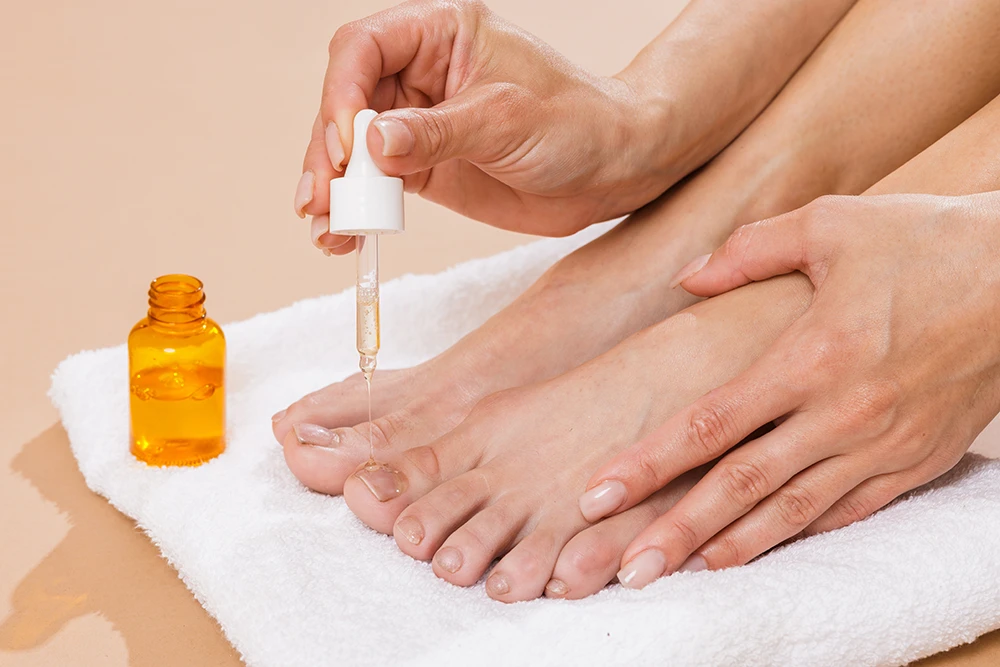
How to apply: Ensure feet or hands are clean and completely dry. Using a clean cotton swab or small brush, apply exactly 1 drop of the diluted blend to each affected nail, working it around and beneath the nail edge as much as possible. Apply twice daily — morning and evening — for the first 14 days.
Important — patch test first. Before applying to the nails, test a small amount of the diluted blend on the inner forearm. Wait 24 hours and check for any sign of redness, burning, or reaction. Thyme, oregano, and especially cinnamon essential oils are known skin sensitizers. If any reaction occurs, do not proceed with this blend and consult with a qualified aromatherapist about a gentler formulation.
Assessing progress: After 14 days of twice-daily application, evaluate whether new healthy nail growth is visible at the base of the nail. Healthy new growth will appear normal in color and texture — not thick, discolored, or brittle. If there is no sign of improvement after 14 days, discontinue this blend and return to your doctor for reassessment. If improvement is visible, reduce to once daily application and continue until a completely new, healthy nail has fully grown in.
How Long Does This Take?
This is the question most people want answered, and the answer requires patience. Toenails grow approximately 1–1.5 mm per month on average — slower in older adults and in colder weather. A full toenail typically takes 12–18 months to fully replace itself. Fingernails grow faster — roughly 3–4 mm per month — and typically replace themselves within 4–6 months.
This means that even if treatment is working perfectly from day one, you will be looking at several months of consistent daily application before a fully clear nail is visible. The key is not to stop treatment when the nail starts looking better — continue until there is a completely new, healthy nail all the way to the tip.
When to Return to Your Doctor
Natural treatment works well for many people with mild to moderate nail fungal infections. However, some situations call for medical reassessment:
- No visible new healthy nail growth after one month of consistent treatment
- Worsening of the infection — spreading to additional nails, increasing pain, or signs of bacterial infection (unusual warmth, swelling, pus)
- Infection spreads to the surrounding skin
- Any underlying health conditions, including diabetes, circulatory disease, or immune dysfunction, that make resolution of the infection more difficult
- Personal preference for a faster resolution — prescription antifungal medications, while carrying their own risks, do work more quickly for many infections
Natural and conventional treatments are not mutually exclusive. Some people use essential oils in conjunction with conventional treatment, or use them to prevent recurrence after a course of prescription antifungals.
Preventing Recurrence
Once you have successfully cleared a nail fungal infection — which you will know only when a fully healthy nail has replaced the infected one entirely — maintaining the habits that prevented it from persisting will help prevent it from returning.
Continue rotating footwear, choosing breathable shoes and natural-fiber socks, drying feet thoroughly after washing and swimming, and avoiding high-sugar dietary patterns. A weekly maintenance foot soak with tea tree oil, or a regular application of a diluted antifungal essential oil blend to the nail area, can help prevent re-establishment of fungal growth in nails that have previously been infected.
This article is for informational and educational purposes only. Nail fungus should be diagnosed by a qualified medical professional before treatment begins. Always consult your healthcare provider before starting any new treatment, particularly if you have diabetes, immune dysfunction, circulatory conditions, or are taking any medications. Essential oils should always be diluted before application to skin and nails. If any irritation or worsening of symptoms occurs, discontinue use and consult your doctor.