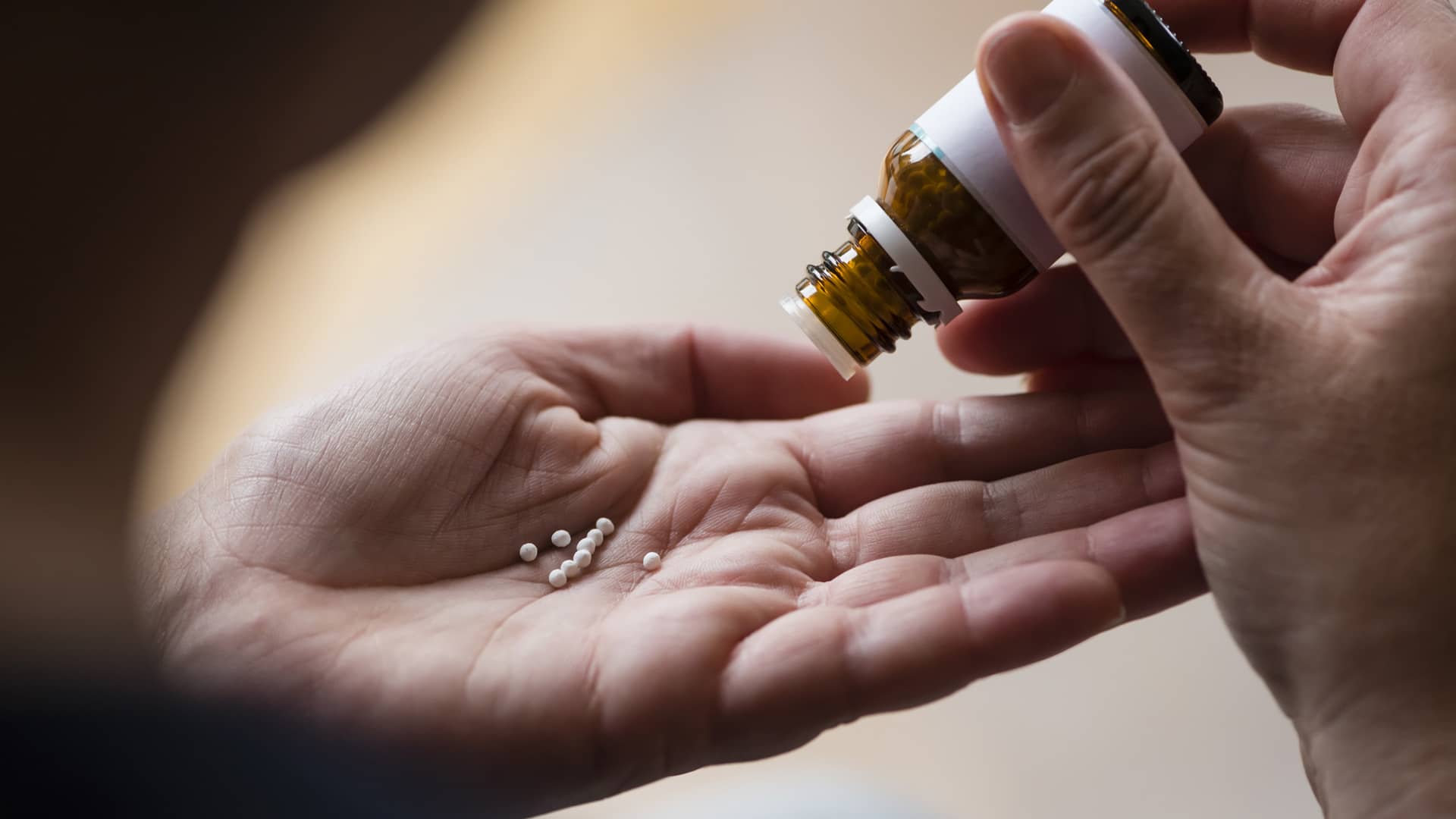
Homeopathy is the most interesting thing I’ve come across in 25 years of medicine. Homeopathy is the method of healing without side effects. I’ve spent 18 years working in a hospital and in my own practice and this has shown me that Homeopathy is the simplest, finest and cleanest method of making people healthy. For me, Homeopathy is the Medicine of the future.
The main criticism of Homeopathy is that there is no conclusive evidence in terms of present day knowledge which validates Homeopathy in therapy.
Homeopathy is for me the best way of healing and I’m saying that out of my experience which is having seen already about 200,000 cases the last 40 years I’m practicing Homeopathy.
For George Vithoulkas, Homeopathy is more than a method of healing. Homeopathy is his life. The 66 year old Greek is considered one of the world’s best practitioners of this form of Medicine. In 1996 he was awarded the Alternative Nobel Prize. He travels around the world, gives lectures, writes books and he treats the sick. It doesn’t leave him much time for fishing.
Germans do not realize that most probably they have produced the greatest man in history. For me, he will be the greatest individual who benefited the planet.
George Vithoulkas was talking about the man who founded Homeopathy, a method of healing which some swear by and others rigorously reject. Today, no less than 200 years ago.
History
His name: Christian Friedrich Samuel Hahnemann. Born in 1755, in Meissen in the east of Germany. Profession: Physician.
Samuel Hahnemann had a lot of children and didn’t earn much. To provide for his family, he had to do translations. He was proficient in 7 languages. In his search for work and an affordable place to live, he moved around a great deal.
Hahnemann had great reservations about the conventional Medicine which consisted mainly of bloodletting and administering emetics and purgatives. He devoted a lot of his time to Chemistry. In one test he carried out on himself, he established that in a healthy person the bark of the cinchona tree triggers a kind of fever that resembles malaria. But a substance obtained from this bark, quinine, is used to treat malaria. From this Hahnemann deduced that the bark causes a kind of pseudomalaria, and that’s why it helps combat the disease itself. And this is how he developed the basic principle of Homeopathy: Similia Similibus Curentur — like cures like.
After countless experiments on himself, he was convinced that sick people should be treated with substances which in healthy people produce similar symptoms to those of the disease in question.
In University lecture halls, his findings were largely dismissed. He was not granted a professorship he had been hoping for.
Undeterred, Hahnemann continued to develop his systematic method of treatment. He called it Homeopathy, from Greek: homoios + pathos, meaning similar suffering. This differentiated it from Orthodox Medicine or Allopathy, which is aimed at opposing the symptoms of any disease.
The remedies carried around in the old pocket first aid kits were made from many different substances — from animal substances, but also from minerals or metals. In that respect nothing much has changed. Over 60% of all homeopathic agents are based on fresh or dried plants. This even includes poisonous plants, such as belladonna or deadly nightshade.
Medicinal plant gardens don’t have to be very big. To produce homeopathic drugs, even tiny quantities are sufficient. First of all, an original tincture is made from the various basic substances. There are about 2,000 different tried and tested homeopathic active agents. In homeopathy every new agent is first tested on healthy persons. The symptoms attained in this way create a specific drug profile. If a patient exhibits these symptoms then, according to the homeopathic Law of Similars, this is the substance that’s exactly right for treatment.
Making medicaments in line with the strict rules laid down by Samuel Hahnemann involves manual work. The special feature of the process is that the original substance is progressively diluted. Homeopathic practitioners call this “potentiating.” One part of the original tincture is attenuated by 9 parts of a water alcohol mixture, and this is shaken up thoroughly 10 times by tapping the container against a firm base. Then 1 part of this is taken and mixed with 9 parts of water-alcohol and shaken up, and so on and so forth.
After a great deal of potentiating, the result is a bit like the proverbial “drop in the ocean.” It’s virtually impossible to detect even a single molecule of the original tincture anymore.
But homeopathic physicians believe that precisely this process of potentiating enhances the remedies’ healing power. The special method of shaking up the solution is intended to charge the preparation with energy, to dynamise it. The idea is that the active agent leaves behind a kind of imprint which is stored by the water’s memory — an immaterial aspect, a sort of energy content beyond the threshold of what is provable.
Healing Power
Homeopathy as a therapy does not focus on treating the substance, that’s to say the illness. Our approach is not taking something out of the substance, the human material, and making a diagnosis. Instead we seek out the essence of the sick person and then treat it with a particular medicine. Whereby it’s not the dilution to the immaterial which represents the immaterial — it’s only the potentiating that counts. That’s to say the dynamising, the power of the medicine taking place in the essence of the medicine.
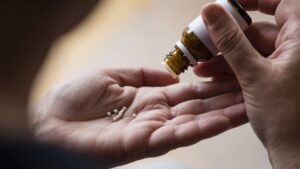
The essence or nature of a homeopathic preparation is not measurable, either in liquid or solid form. The active agent is dripped into water, called globuli — little balls of lactose.
The potentiated energy cannot be determined by scientific methods, or not yet, according to homeopathic practitioners. It won’t be until some time in the future that man will be able to establish how this power from nowhere actually functions. For the time being the advocates of homeopathy are quite content to point to the efficacy of their methods. Homeopathic remedies are much cheaper than comparable medicinal drugs. German companies are among the world’s leading producers.
Classical Homeopathy
From Germany, to Alonissos in Greece. Many years ago George Vithoulkas discovered this island in the Aegean for himself and for homeopathy. In 1995 he founded the International Academy of Classical Homeopathy.
I had to persuade the whole world that this was a valid system of Medicine. And not that I have persuaded them now. Still, there’s a lot to be done. This Academy is a means, is a tool through which this can be done. So in this Academy I’m able now to give all the knowledge from A to Z to the people who are interested.
Similia Similibus Curentur — the homeopathic principle as a floor mosaic. This Academy is a magnet for physicians and other homeopathic practitioners from all over the world.
George Vithoulkas wants to improve the standard of homeopathic training, because he regards it as often inadequate at present, not governed by any uniform rules.
In the past, the Greek expert was rejected even within the homeopathic community because he is not a qualified physician. Nowadays though, he is accepted and recognized, even without a doctor’s title.
George Vithoulkas initiated a Renaissance of Homeopathy, and the fact that it is so widespread today is also thanks, at least partly, to him. He is a representative of Classical Homeopathy, based directly on Hahnemann’s own teachings. Today there are also various other schools.
The participants in these seminars study individual cases, examine the symptoms and try to determine the appropriate homeopathic remedy.
One of the participants is a physician from Germany. Dr. Gupfordgayer is back in her joint practice in Berlin, where she’s been working as a pediatrician for over 20 years. In the past years she’s become increasingly interested in homeopathy.
Only 1% of doctors in Germany are homeopathic practitioners. A good homeopathic physician has to complete many years of training. It’s a method that requires intensive study. But in fact many non-homeopathic doctors also prescribe homeopathic preparations without first acquiring the necessary expertise.
Dr. Gupfordgayer spent ages looking for alternatives to orthodox medicine. She had increasing doubts about the wisdom of conventional methods of treatment and conventional medicinal drugs.
What I observe again and again, if I have to administer conventional medicinal drugs on a frequent basis, is that they have side effects. For example, a child with chronic inflammation of the ear or pneumonia — if it’s given antibiotics again and again, it gradually loses its powers of resistance. It becomes ill again more quickly, and frequently it also suffers emotionally. On the other hand, when I choose the right homeopathic remedy, the child not only loses this chronic sickness — the child becomes emotionally healthy as well.
Motivated by such observations, Dr. Gupfordgayer is using homeopathic methods of treatment more and more. For example with 8 year old Janek and his sister. Since birth both children have suffered from neuro-dermatitis. After treatment with a homeopathic remedy, their chronic eczema disappeared. And the interesting thing is that both children were given a different homeopathic preparation.
Finding the most appropriate remedy entails long discussions in which the doctor asks detailed questions about all the symptoms. Everything is carefully noted down. It’s not just Janek’s eczema that disappeared — so too did his extreme timidity.
Ideally, homeopathic treatment influences not just the body but also the mind and the soul. The homeopathic agent is meant to act as an intermediary substance, stimulating the body’s powers of self healing. Under the German health insurance system, homeopathic doctors are not recompensed for the great amount of time they spend with each patient. So they often earn less than their orthodox colleagues. All the same, Dr. Gupfordgayer is convinced. Once you’ve seen how effective homeopathy is, it would be irresponsible to apply orthodox medicine. If her financial situation permits, she wants to work exclusively on a homeopathic basis.
Hahnemann
In 1821 Samuel Hahnemann moves to Kothen, a small town in the east of Germany. He is now 65. His waiting room is always crowded. His therapeutic successes have earned him a reputation well beyond the borders of Germany. He has a growing number of followers.
Among those who champion him is Ferdinand, the Duke of Anhalt-Kothen. Hahnemann becomes the duke’s personal physician. In this capacity, he often visits the duke at his palace.
With his new form of Medicine, Hahnemann had made many enemies among physicians and apothecaries. But under the protection of the duke he enjoyed a certain freedom — for instance, he was now allowed to produce his remedies himself, which he considered important in order to ensure uniform quality. He had been forced to leave Leipzig because he was officially prohibited from making his own medicinal drugs, at the instigation of the apothecaries who openly opposed him.
In Kothen Hahnemann dealt extensively with chronic diseases. While accepting that particular types of skin disorder can disappear after treatment with salves and ointments, he took the view that the disease hadn’t actually been cured — it had simply moved inside the patient’s body. As a result, Hahnemann concluded the patient would later have other organic and also mental suffering.
In 1831, cholera broke out in Europe. Long before scientific awareness of bacteria, Hahnemann believed that the disease was transmitted by minute organisms. With hygiene and homeopathic treatment he achieved amazing results, and his reputation spread across the continent.
We don’t claim that we can cure everything, but we claim that homeopathy would be best applied at the beginning of chronic conditions and chronic stages. And then people can be spared a lot of suffering.
George Vithoulkas in the German capital, Berlin. Homeopathic practitioners are holding a world congress here. One of the highlights is a lecture by the Greek expert.
In Germany, in particular, he has many followers.
We should use our common sense. This is my answer: if somebody doubts, they can come and they can try themselves and find out whether they are cured or not. In this matter, critics do not count. I was sick and I was cured. Whether you criticise or don’t criticize, I don’t care. This is what the patients say.
Here, George Vithoulkas doesn’t have to defend his views. Elsewhere, homeopathy comes in for a lot of criticism — sometimes polemical, sometimes phrased more moderately.
Homeopathy Under Scrutiny
I judge Homeopathy by the standards of pharmacology. And pharmacology is a discipline concerned only with active agents. And I’m afraid, in any experimental sense, active agents are something homeopathy doesn’t have to offer.
So far no scientific study has been able to prove the efficacy of homeopathic remedies beyond all doubt. So, is homeopathy based just on the placebo effect?
Homeopathy is also used in veterinary medicine. But critics refuse to accept this as evidence of efficacy, saying that animals can also be influenced psychologically in the same way as human beings. In some cases though, this is difficult to imagine.
On this farm in northern Germany, veterinary surgeon Dr. Schutte was called in to treat a cow by the name of Umbelina. More or less, all of a sudden she had stopped producing milk. After excluding any possibility of organic damage, the vet administered a homeopathic remedy. Just 12 hours later, the cow was producing as much milk as before. Following a second treatment a few weeks later, the effect was repeated.
There are such definite successes, and they occur so quickly after treatment, that I can only say that they must have been brought about by the homeopathic remedy. They can’t be caused by anything else. I’ve been applying this method for over 13 years now and I have achieved success in so many cases, including cases which were regarded more or less hopeless. And that has convinced me.
Are orthodox doctors simply protecting their own interests? This is a whole complex of established medicine and pharmaceutical companies. Billions of marks, dollars are going towards this kind of research. And the whole humanity is waiting to find a remedy that will cure cancer, a remedy that will cure AIDS, or a remedy that will cure any chronic disease.
George Vithoulkas has taken up arms against the medical establishment. And just like Hahnemann himself, the Greek expert is attacked for poking around in the domain of orthodox medicine.
You have asthma, you have to take cortisone for the rest of your life. This is not a cure — it’s just suppressing the symptoms. So, which chronic disease has allopathic medicine cured, in spite of billions of dollars going to research?
Hahnemann also refused to be deterred. In 1835, Hahnemann married a young French woman and moved to Paris. In the French capital, he became a fashionable physician. Patients came from abroad to consult him.
One of his patients was the Italian violin virtuoso Nicolo Paganini. In his patient’s journal, Hahnemann kept a scrupulously detailed account of the great musician’s medical history.
For the German physician, exile in Paris was a triumph. After decades of deprivation, Hahnemann finally enjoyed prosperity, and his successes made homeopathy better and better known.
Samuel Hahnemann died in 1843 at the age of 88. His grave in the famous Père Lachaise cemetery in Paris is a monument to a man who changed the world of Medicine.
In France the new method of treatment quickly became established. In the streets of Paris, there are pharmacies everywhere selling homeopathic preparations. They are officially recognized, and sales of such products have been rising for years. For homeopathic manufacturers in Germany, France is a very important export market.
But the practice of homeopathy isn’t confined just to Europe. Hahnemann’s teachings spread around the world. His popularity is most widespread in India. Homeopathy reached the subcontinent even in the 19th century and quickly became established. Mahatma Gandhi was one of those who favored it.
The Nehru Homeopathic Hospital in New Delhi sees between 500 and 600 people a day for outpatient treatment. Over half a million people practice homeopathic Medicine in India — more than in any other country. Homeopathic remedies are favourably priced and the method doesn’t call for expensive apparatus, important reasons for its broad base there.
It’s almost a tradition. You have homeopathic hospitals and homeopathic pharmacies and homeopathic doctors in each and every town, in every small village in India. And we have hundreds of homeopathic colleges in India. And it’s also official.
The hospital in New Delhi is also a medical college for homeopathy, with 220 students. The course of training in this discipline lasts 5 years. In India, about 17% of all doctors practice homeopathic medicine.
Patients go straight to the hospital’s own pharmacy to collect their prescriptions. India is a huge market for homeopathic medicines. The country could pioneer the further spread of this method of treatment in Asia.
Thanks to George Vithoulkas, homeopathy has gained in reputation. He’s helped to give many homeopathic practitioners more faith in themselves, he’s taken charge. He’s imposed stricter standards of teaching and learning. He looks forward to the future with confidence.
I believe the future is in homeopathy, there is no question about that. But when will this come? When will homeopathy be established as the main therapeutic methodology? I cannot say. Maybe 50 years from now, maybe 150. But definitely it will be the Medicine of the Future.
A bold vision — one that many may reject. But 200 years after Hahnemann’s “Similia Similibus Curentur,” like cures like, one thing is certain: homeopathy can definitely no longer be ignored.