Can homeopathic potencies be scientifically detected and measured? Dr. Karin Lenger presents groundbreaking research identifying homeopathic potencies as magnetic photons using a newly developed Tesla coil magnetic resonance method — placing homeopathy on a measurable, physical scientific foundation for the first time.
Author: Karin Lenger, Ph.D. Published in: Subtle Energies & Energy Medicine, Volume 15, Number 3
Abstract
This article presents research on the detection of magnetic photons in homeopathic potencies. Using a newly developed magnetic resonance method with two different Tesla coils generating longitudinal waves at distinct resonance frequencies in the high-frequency (HF) range at low micro-voltages, the electromagnetic properties of homeopathic potencies were investigated.
When placed into the maximum of the magnetic field, high homeopathic potencies with frequencies in resonance with those of the coils attenuated the magnetic field — leading to the conclusion that homeopathic potencies consist of magnetic photons.
For the first time, the degree of each potency was measured and characterized by its specific µV input level, which separated the photons from their carrier molecule of sugar at their resonance frequency. Each homeopathic potency carries several frequencies in the HF range with distinct energies. This paper also presents, for the first time, a method for determining the full frequency spectra of homeopathic potencies.
The conclusion drawn is that each homeopathic potency has a specific frequency spectrum and a specific energy — what may be termed “homeopathic information.” These findings place homeopathy on a fundamental scientific and physical basis, providing a measurable explanation for how it functions. Healing through homeopathy is understood as exciting or attenuating the energy levels of pathological pathways through magnetic photons, according to the resonance principle. Homeopathy, in this framework, is an energetic medicine.
Keywords: Homeopathy, homeopathic frequency spectra, homeopathic potencies, excited states, energy terms, magnetic resonance, longitudinal waves, magnetic photons, Tesla coils
Introduction
The mystery of homeopathy and its mode of action has not been fully resolved by conventional science. Healing effects are achieved using substances diluted beyond the Loschmidt constant, with vigorous shaking — called succussion — performed between each dilution step.
Samuel Hahnemann (1755–1843), the founder of homeopathy, described these preparation methods and argued that healing obeys the principle of similarity: the symptoms of the patient are similar to those produced in a healthy volunteer exposed to the same substance. The highly diluted and shaken substance appears to cure the patient by transferring some form of “information” or oscillatory wave — though no further physical explanation existed until now.
Researcher Fritz-Albert Popp proposed that all living organisms exist in excited and non-excited states, regulated by the absorption and emission of biophotons. He theorized that illness could represent a state of too much or too little energy, and that homeopathic healing might function by solitons or photons exciting the basic energy state or deleting excess energy via resonance. However, no method existed to prove this theory experimentally.
Physicist Konstantin Meyl extended Maxwell’s electromagnetic wave equations to include potential vortices swinging as longitudinal waves, demonstrating that both transverse and longitudinal waves can be interconverted using low energies. Using Tesla coils, longitudinal waves can be generated at specific frequencies in the HF range using micro-voltages — providing a potential tool for measuring the electromagnetic fields of homeopathic potencies.
Procedures
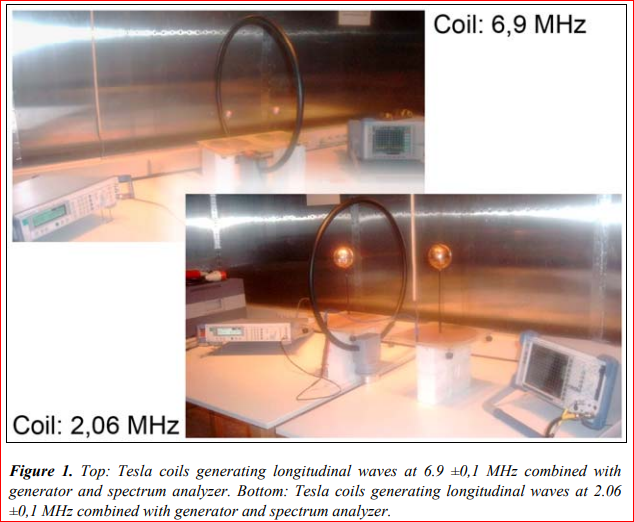
All measurements were performed within a Faraday cage (3 × 3 × 12 m; attenuation up to 86 dB of environmental electromagnetic fields) to eliminate interference from external electromagnetic sources.
Resonance frequencies were adjusted so that longitudinal waves were generated only when the diode at the receiving coil was energized. Electromagnetic fields were measured using a probe set for E- and H-near-field measurements (HZ-14, 9 kHz to 1 GHz, Rohde & Schwarz).
A support for glass tubes containing four globuli of homeopathic potencies was placed into the maximum of the magnetic field, 2–3 cm from the edge of the coil. Homeopathic potencies of D 200, C 200, D 1000, C 1000, 200K, MK, XMK, LMK, CMf, and neutral sugar globuli were used. The Spectrum Analyzer was configured to measure both the attenuation of the magnetic fields and the different spectra of homeopathic potencies.
Results
Electromagnetic Fields of Tesla Coils
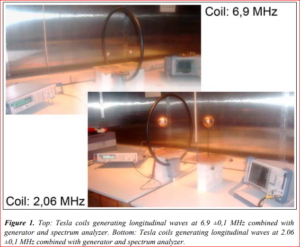
All experiments were conducted within the Faraday cage to exclude transverse Hertz waves. Two flat Tesla coils — a transmitter and a receiver — generated longitudinal scalar waves at resonance frequencies of 6.9 MHz and 2.060 MHz respectively, supplied by constant micro-voltage input.
The maximum of the magnetic field was found 2–3 cm from the edge of the coil, with the electric field adjoining toward the middle. The induced fields differ from those of a toroidal coil, and further investigation into their properties is ongoing.
Attenuating the Magnetic Field of Tesla Coils With Homeopathic Potencies
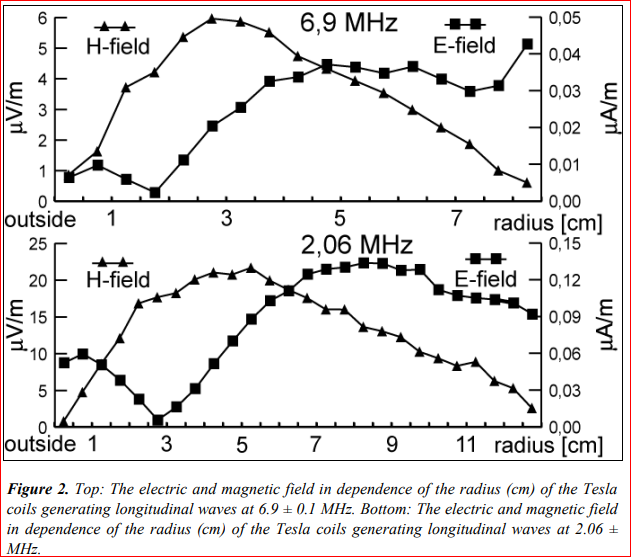
Initially, high homeopathic potencies such as XMK, LMK, and CMf were placed into the electric fields of the transmitter coil, yielding no result. When the same potencies were placed into the maximum of the magnetic field using a near-field magnetic probe, significant results were obtained.
Using a special H-field loop antenna (1 m diameter) oriented at right angles to the coil’s magnetic field, the Spectrum Analyzer confirmed that the magnetic fields of the Tesla coils (6.9 MHz) were attenuated by the high potencies of:
- Argentum metallicum D 1000, C 1000, MK, XMK, LMK, CMf
- Cantharis (with increasing attenuation corresponding to increasing potency)
Capsicum and Arnica in LMK and CMf showed values equivalent to the sugar placebo globuli, indicating they have no resonance frequencies at 6.9 MHz. Water in high potencies such as XMK showed no effect.
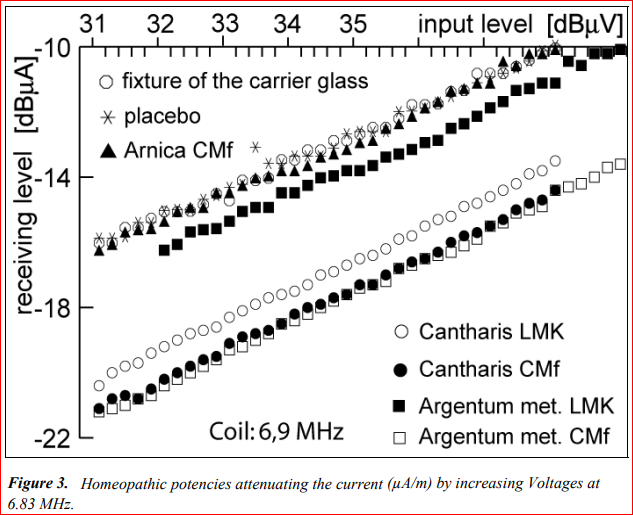
These results confirm that homeopathic potencies consist of magnetic photons that resonate with the magnetic field and longitudinal wave of the Tesla coils. This formed the basis for a new magnetic resonance method for measuring homeopathic potencies.
Separation of Homeopathic Photons From Their Carrier Molecule
For the first time, the degree of a potency was measurable through its specific input voltage — the µV level required to separate the homeopathic energy from the sugar carrier molecule by forming a standing longitudinal wave in the Faraday cage.
After separation, the spectrum of the cleared globuli was identical to that of the placebo, confirming that the globuli were free from any homeopathic potency. The energy level of the spectrum analyzer did not return to zero due to the standing wave within the Faraday cage; the cage door was left open for approximately 20 minutes to allow dissipation, after which the analyzer returned to white noise.
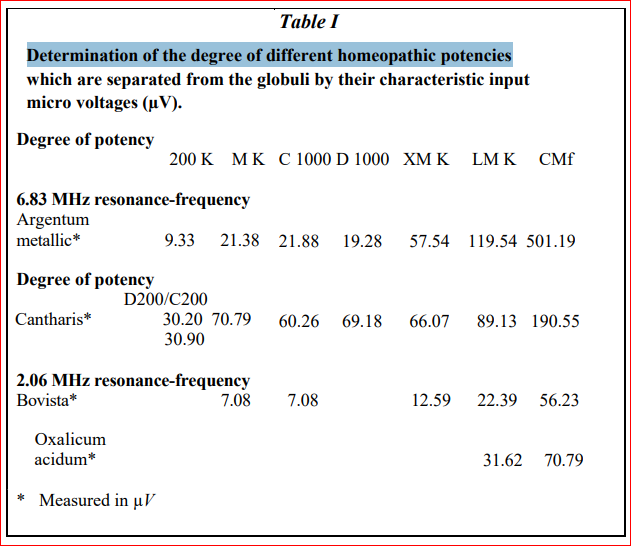
Accuracy: The maximum mean deviation of measurement was ±3%, confirming full reproducibility of all values.
Degree of Potencies
The separating input voltage is proportional to the degree of potency — lower potencies require lower µV values, higher potencies require higher ones. A linear relationship exists between potency level and required input voltage for each remedy:
- Argentum metallicum: 9.33 µV (200K) to 501.19 µV (CMf)
- Cantharis: 30.20 µV (D 200) to 190.55 µV (CMf)
- Bovista: 7.08 µV (MK) to 56.23 µV (CMf)
Each homeopathic remedy is characterized by a specific µV value for detaching its magnetic photons. This confirms that each homeopathic potency contains a distinct energy level.
Importance of the Number of Succussions
Experiments revealed that the binding energy of potencies of the same degree — such as Argentum metallicum MK, C 1000, and D 1000 — is nearly equal at 6.9 MHz, regardless of their dilution factor. This indicates that concentration is not the critical factor. Rather, the number of succussion steps determines the energy level.
This finding confirms Hahnemann’s own assertion that the number of shakings — not the concentration — is what matters. Experiments further showed no measurable difference between potencies prepared by hand or by machine, contradicting a long-held belief among homeopaths that manual preparation is superior.
The Highest Energy Is Found in Highly Succussed and Highly Diluted Potencies
As long theorized, energy in homeopathic potencies grows with increasing numbers of shaking steps and is inversely proportional to the degree of dilution. CMf potencies — the highest dilution factor tested — exhibited the highest energy values, in contrast to lower potencies such as 200K or MK.
Frequency Spectra of Homeopathic Potencies in the HF Range
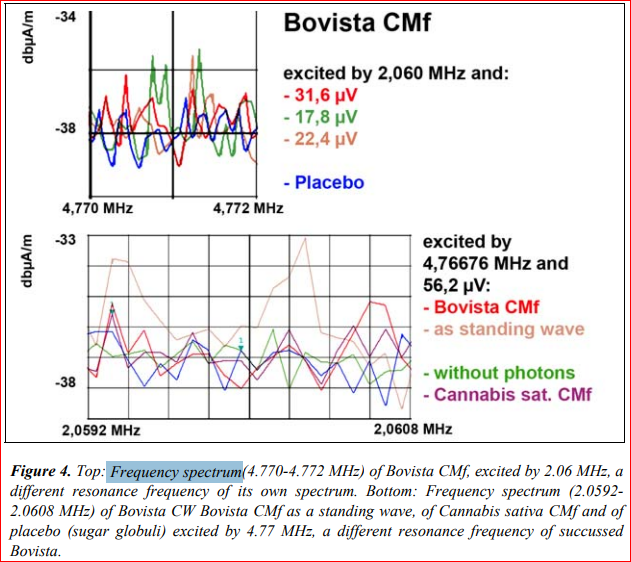
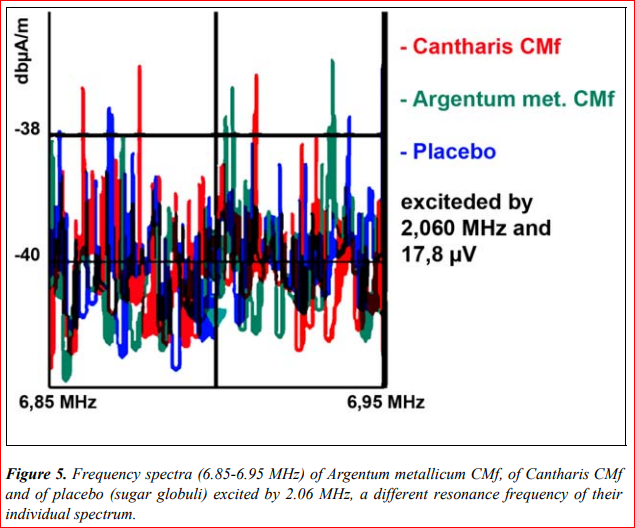
No prior method existed for measuring frequency spectra in the HF range (1.6–30 MHz). The newly developed Tesla coil method was extended to measure these spectra by exciting potencies with a different resonance frequency from their own individual spectrum for 35 minutes.
Findings include:
- Bovista CMf: resonance frequencies at 4.77 MHz and 2.059 MHz
- Argentum metallicum: frequencies at 2.06, 6.96064, 7.008, 7.1027, and 7.18848 MHz
- Cantharis CMf: frequencies at 2.06, 6.84, 6.92912, 6.8344, and 7.16504 MHz
- Cannabis sativa CMf showed no resonance under the same conditions
- Arnica LMK showed no resonance at 6.9 MHz and served as a blank value
Conclusion: Each homeopathic remedy consists of specific energy and multiple frequencies in the HF range. Each potency has its own unique frequency spectrum.
Discussion
Identification of Homeopathic Potencies as Magnetic Photons
For the first time, homeopathic potencies have been identified as magnetic photons. Their degree and frequency spectra within the HF range are now measurable. Placing potencies into the electric field of the coil produced no results, confirming that homeopathic potencies consist of magnetic — not electric — photons.
Comparison with previous methods: The Nuclear Magnetic Resonance (NMR) method attempted by Weingartner used 300 MHz and extremely high field strength — conditions under which photons would likely separate from the water molecule immediately, and which are probably outside the resonance frequencies of the remedies in the HF range (1.6–30 MHz). Earlier researchers
also used potencies that were likely too low to produce signals above noise level.
Formation of Photons
According to Meyl, each electromagnetic wave can be transformed into an electric or magnetic potential vortex forming a scalar wave. Material substances — including the plant or mineral extracts used in homeopathic preparation — consist of compressed electromagnetic wave packets with multiple wavelengths.
During succussion, the agitated electromagnetic fields induce new fields that interfere and superpose, causing the formation of photons — wave packets curled into magnetic vortices. With increasing succussions (as represented by the Lorentz force), these vortices are compressed, wavelengths shorten, and frequencies increase. This is why higher potencies have higher energies and higher frequencies. This entire process constitutes an energy transformation.
This framework also explains the experiments of Benveniste, who worked with highly diluted, vigorously shaken extracts — conditions that would generate photons of higher energy. Hahnemann himself observed that his diluted preparations contained no molecules but could not account for their healing effects. The current research suggests he had unknowingly transformed material substances into high-energy magnetic photons, consistent with Einstein’s formula E = mc².
Frequency Spectra
Homeopathic potencies demonstrate multiple resonance frequencies in the HF range — a departure from classical photon behavior, in which a photon is characterized by a single frequency (E = hν, monochromatic light). The high potencies tested displayed distinct multi-frequency spectra, each unique to the remedy.
Each homeopathic potency has a characteristic frequency spectrum, supporting the view that the homeopathic pharmacy consists of magnetic photons with varying frequency spectra in the HF range. Whether additional frequency spectra exist in other ranges — such as the 220–550 nm range in which Popp identified biophoton spectra — remains an open question for further research.
Energy in C-, D-, and K-Potencies
The characteristic separating energy (µV) for potencies of the same degree — such as MK, D 1000, and C 1000 — is nearly equal, despite different concentrations, because they share the same number of succussions. This provides physical evidence for Hahnemann’s claim that the number of succussions, not the concentration, is what determines potency. The distinction between “hard” D-potencies and “soft” C-potencies, and the dismissal of machine-prepared K-potencies, is shown to be without scientific basis.
“Information” and “Memory” of Homeopathic Potencies
The concept of “water memory” in homeopathy can be reinterpreted through this research. Rather than the water molecule itself having memory, structural changes in water are caused by photons with specific frequencies binding to the magnetic poles of water molecules. The so-called memory effect of water is, in this view, a property of the magnetically bound photons and their characteristic electromagnetic wave packets.
“Homeopathic information” is therefore the magnetic photon itself — with its intrinsic electromagnetic wave packet and multiple frequencies transformed by succussion into higher frequencies at higher potency levels.
Regulation of Life Through Biophotons
Life, in Popp’s framework, involves the constant absorption and emission of biophotons to regulate the coherent electromagnetic field stored in the DNA. The organism functions simultaneously as a transmitter and receiver of biophotons.
Extending Popp’s theory: biophotons absorbed transform biochemical pathways onto higher energy levels. When the respective pathway is completed, unused photons are emitted into the environment. This framework may also explain how allosteric enzymes obtain the energy needed to change conformation during catalysis — through the absorption of biophotons.
Healing by Homeopathy
Illness, in this model, represents a disturbance in the regulation of the organism’s electromagnetic field — a change in its characteristic frequencies. Homeopathic healing achieves regulation of the disturbed electromagnetic field through resonance between the frequencies of the potency and the pathological pathway.
During illness, the pathological pathway passes through various morbid energy states, each corresponding to the frequency of a distinct homeopathic potency. When the appropriate potency is administered orally, the photon is separated from its sugar or water carrier by the low voltages of the body. The free photon, resonating with an energy term of the pathological pathway, either excites it to a higher energy level or deletes excessive energy through phase-dependent interference.
This transforms the pathological pathway to a new energy level, which may then require a different potency with a different frequency. Healing proceeds step by step, through a hierarchic sequence of remedies, each shifting the frequencies of the pathological pathway toward coherence. In this framework, Hahnemann’s law of similarity reduces to the principle of resonance: similar resonance frequencies between the remedy and the energy terms of the pathological pathway.
Save the Homeopathy
Many high-potency remedies — including nosodes such as cholera LMK and yellow fever LMK — are no longer available due to increasing regulatory restrictions. A European Union law requiring the destruction of original substances used in high-potency nosodes and snake venoms is based on a misunderstanding of how homeopathy works. In high potencies, no molecule of the original substance remains — only magnetic photons. Destroying the original substance will result in potencies whose photons no longer correspond to the original substance, undermining their therapeutic specificity.
References
- Hahnemann, S. Organon der Heilkunst. Hippokrates Verlag, Stuttgart, Germany, 1979.
- Popp, F. A. Hypothesis of Modes of Action of Homeopathy. In Energetische Medizin (P. Heusser, Ed.), Peter Lang AG, Bern, 1998, pp. 101–110.
- Bischof, M. & Popp, F. A. Biophotonen, Das Licht in unseren Zellen. Verlag Zweitausendeins, Frankfurt, 1995.
- Meyl, K. Elektromagnetische Umweltverträglichkeit, Parts 1–3, 2003; Tesla, N. Patent No. 645,576/1900.
- Bischof, M. Tachyonen Orgonenergie Skalarwellen. AT Verlag, Aarau/Schweiz, 2002.
- Signal Generator SML and Spectrum Analyzer FSP 40 (9 kHz–40 GHz), Rohde & Schwarz; Tesla coils produced by Schwille-Elektronik, Kirchheim/München.
- Weingartner, O. Kernresonanz-Spektroskopie in der Homöopathieforschung. KVC Verlag, Essen, 2002.
- Belavite, P. & Signorini, A. The Emerging Science of Homeopathy. North Atlantic Books, Berkeley, California, 2002.
- Davenas, E., et al. Human Basophil Degranulation Triggered by Very Dilute Antiserum IgE. Nature 333 (1988), pp. 816–818.
- Schiff, M. Das Gedächtnis des Wassers. Zweitausendeins, Frankfurt, 1997.
Correspondence: Dr. rer. nat. Karin Lenger, Dipl. Biochem. Naturheilpraxis für klassische Homöopathie Kaiserstr. 28, D-63065 Offenbach, Germany
Source Publication: Subtle Energies & Energy Medicine, Volume 15, Number 3, Pages 225–243